
Editor's Note: Every 50 years or so, gold returns front-and-center to steady the world’s monetary system. We are closer to the moment than we’ve been since 1918. Team Trump is overturning the current system in favor of one that – if successful – will restore the US to financial sanity… and send gold up to absurd new highs. That’s why you need to know about the Top Four miners with 100X potential. If you haven't already read my briefing on, what I call, the "Golden Anomaly" go here, you don't want to miss this.
No market is as full of conspiracy theories, half-truths and imaginative story-telling as gold. It’s part of the reason why investing in gold miners is both fraught with risk, but also ripe with opportunity.
For people who can’t tell the difference, it might seem like magic when a gold investment pans out, or a mystery when it doesn’t.
But it’s not magic, or a mystery. It’s just that gold marketers are experts at making things more complicated or interesting than they need to be.
If you’ve paid any attention at all to the people in this business, you’ve probably heard about the concept of “draining the Comex.”
Today I’m going to hopefully raise the veil on this idea… and why I think it’s not very likely to occur any time soon.
To understand the price of gold, you (unfortunately) need to comprehend the futures markets, specifically the Comex.
The basic gist: the Comex is the world’s largest futures and options market for metals like gold, silver, copper, etc.
When you hear the “spot” price of gold, it’s settled by the London Bullion Market Association, which is heavily influenced by the futures contracts settled at the Comex.
Normally, a small percentage of futures contracts are settled by someone taking physical delivery of actual gold bars. Even during the last major bull run that terminated in 2012, relatively few contracts ended up standing for physical delivery. It’s pretty typical to see something like 99% of contracts end up being cash settled.
A simplified example: say you bought a $1,000 contract (which gives you the right to buy gold at $1,000 oz) and then gold goes to $1100. in this case, you could take delivery of the gold at $1,000 (net of delivery fees) and then be happy you own gold at 10% under the prevailing price, or you could sell the contract back and profit $100 in cash.
It works out for the party selling the contract too, because if you ask for physical delivery, they have to pony up the gold, possibly by buying it in the open market. It’s easier to just send you $100.
I know people want to paint this paper gold market as a kind of conspiracy, and there’s some evidence for it, but on the other hand: if global financial powers want to artificially suppress the price of gold, I’ll take the other side of that arrangement for as long as I can. The end result will be that I own more gold and gold investments – with higher potential profits.
All of that to say: most of the time, gold traders are satisfied to simply cash settle.
But since 2021, that’s started to change. It’s impossible to pin down exactly why more contracts are standing for delivery. Maybe it has something to do with the heavy financial sanctions placed on Russia following the invasion of Ukraine.
That reasoning would make sense, since central banks have been on a gold buying spree since around that time. If you own gold, the US can’t exactly sanction it.
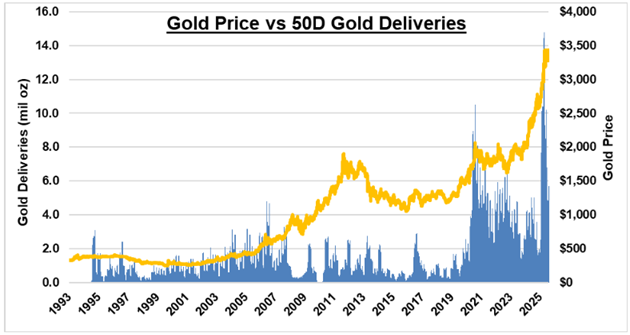
You can see in this chart, there have been some massive spikes in gold deliveries – shooting to over 14 million ounces in a 50 day period. That might seem like a lot of gold, and it is – coming out to over 400 metric tonnes. That’s about 10% of annual worldwide gold production.
It’s even a significant amount relative to what the Comex holds in its vaults. 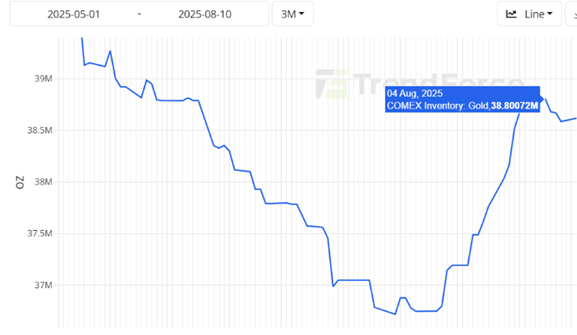
This chart shows Comex vaults have held between 37 million and 40 million ounces over the past few months.
But you also have to consider that almost all of the gold ever mined still exists, sitting in vaults somewhere, or in coins, jewelry, etc.
At a high enough price, that gold will get melted down and/or sent (eventually) to Comex. In other words, the theory about “draining the Comex” is possible, but not plausible – or at least not imminently plausible.
It’s still an interesting data point to see physical delivery spike like we’ve seen recently, especially as the spike has coincided with higher gold prices.
It’s already at multi-decade highs. And from my experience, the price of gold tends to do very well when Comex traders are taking physical delivery.
It’s something I keep daily tabs on, so I’ll keep you posted.
Stay tuned.
Garrett Goggin, CFA, CMT
Lead Analyst and Founder, Golden Portfolio