The Federal Reserve is meeting this week and it appears we’re going to see them cut rates again – for the 3rd time this year.
The Fed cut rates in both September and October – just 0.25% each time.
These rate cuts are important information for gold traders if not gold investors, because at the margins, U.S. Treasury bonds are in competition with gold. Low yields on bonds make gold appear more attractive. The thinking is: if you’re not going to get any yield, you might as well own a real asset that isn’t actively being inflated away.
Since the Fed’s last rate cut on October 29th, gold prices have mostly trended sideways:
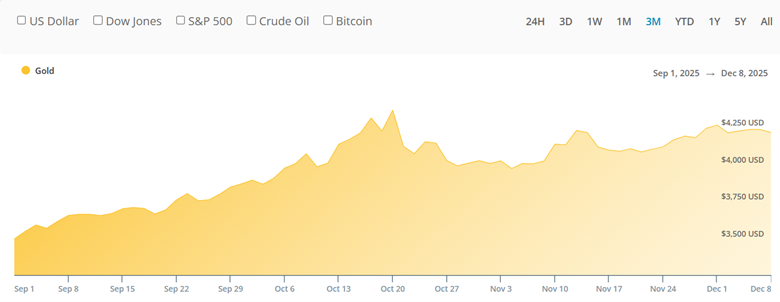
Sometimes you see this kind of price action when the market might have been anticipating a bigger cut. Nevertheless, lower Fed rates tend to be bullish for gold.
Over the past 20 years, we’ve had several rate-cut eras, and they all resulted in higher gold prices.
In 2008, as the U.S. stock market cratered, the Fed slashed rates to near zero. In response, gold rose 12.8% in 2009 alone.
During the 2020 Covid outbreak, the Fed again cut rates and gold moved from $1,500 to $1,700 – a more than 20% jump.
Now we’re in the middle of another rate-cut period – and gold is near all-time highs. The difference? The Fed is cutting rates without a present and obvious crisis to fight.
Unlike in 2008 and 2020, stocks are also near all-time highs. In fact, it’s not just gold that’s near record highs. Silver and copper are both roaring. Even 10-year bond yields – despite a half-point cut over last year, are almost exactly where they were a year ago:
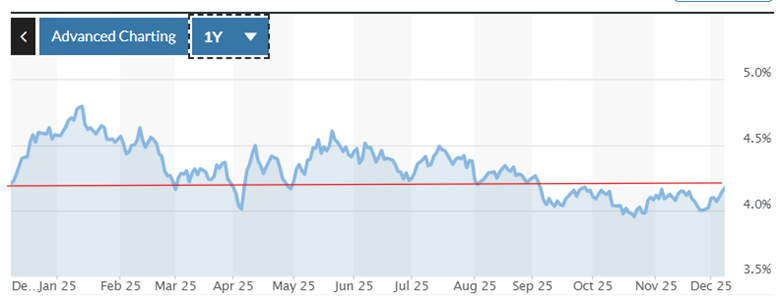
The difference could be huge. Cutting rates while asset prices are already elevated is something that we haven’t really seen. Typically and historically, the Fed would cut rates in an effort to cool prices.
What’s changed?
I think we’re looking at the slow-motion end game of monetary policy. The Fed is squeezed between two mandates of maximum employment and low, steady inflation.
But the real game the Fed has been playing since at least 2008 is to not let asset prices crash. The game is now to keep the money moving in an effort to generate a “wealth effect.”
The elevator pitch for this policy is that if you feel rich, you will act like you are rich, and you’ll spend money – even if you’re actually less well-off thanks to inflation.
It’s not the kind of policy you would pursue if you had any sane, rational tools left that would lean towards solvency and prudence.
The Fed now has the choice of stomping on the brakes to cool asset prices which could completely choke out the economy – OR – to stomp the gas to keep the whole thing moving.
They’re stomping the gas.
Historically this kind of policy has been very good for gold.
There’s no real reason it shouldn’t be this time – and yet, gold is still catching its breath after the massive run-up over $4,000 this past summer. Gold stocks have been taking a similar breather, with some of my favorites still holding flat since gold topped $4,400.
That is going to change very soon.
We don’t know when the sideways action will end. But keep an eye on the Fed’s announcement this week…
The end of the year is always a hectic time, but when people wake up on January 1st and start thinking about 2026, I know some of the world’s best gold stocks will be on their list.
Take a look at what I’m telling my paid readers to buy before the New Year.
Best,
Garrett Goggin, CFA, CMT
Lead Analyst and Founder, Golden Portfolio