Editor’s Note: If you’re a Golden Portfolio IV member, you should definitely check out the latest update and portfolio information. Reminder that we publish new issues every quarter and provide news updates as necessary.
Since January 1st, we’re sitting on gains over 50% on the 5 positions in the portfolio – crushing stocks and even outperforming major gold indexes and ETFs.
If you’re not yet a subscriber to Golden Portfolio IV, to access the full paid issues, the portfolio, and all of our insights and recommendations, Please Click Here.
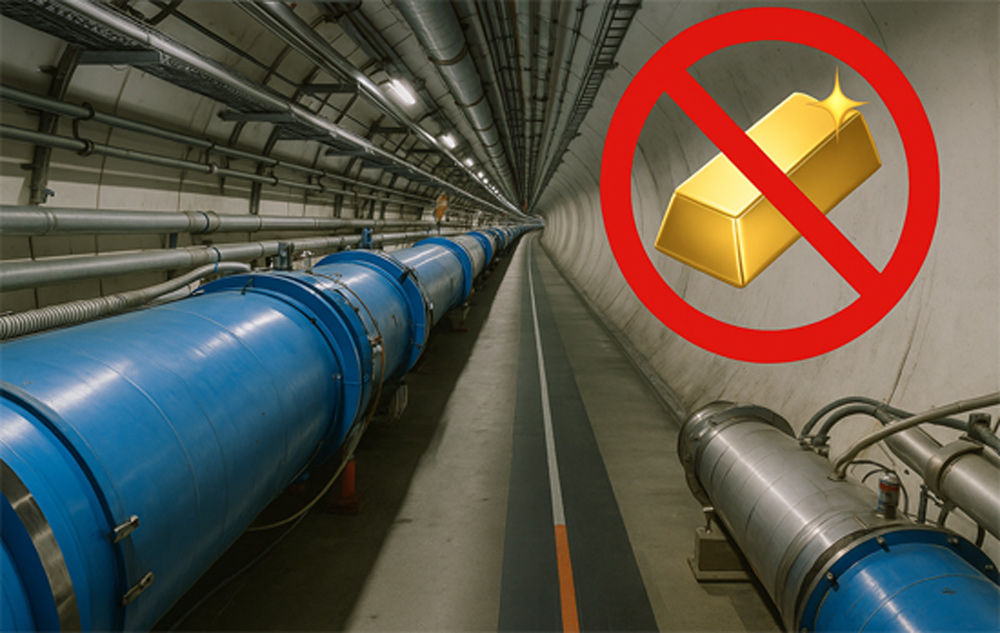
The media is abuzz with gold bears proclaiming the end of the gold bull thanks to a story about the European Organization for Nuclear Research (CERN) and their large hadron collider that turned lead into gold.

Whenever there is a bull market in gold, you’re guaranteed to hear some absurd new story about how “scientists” have discovered some new way of producing gold that could flood the market, and fundamentally derail gold as a rare monetary asset.
We’ve all heard about massive asteroids that hold millions (or billions) of tonnes of gold/silver/platinum, etc.
Years ago, I saw a story about mining gold from seawater. Of course, there are many billions of tonnes of gold in seawater. There are gold-laden asteroids.
And very technically speaking, CERN did create a few atoms of gold that lasted for far less than a millisecond before being dashed into nothing inside the large hadron collider.
What you don’t hear from these journalists or the scientists they’re writing about is that mining the ocean or asteroids or using advanced particle accelerators to make gold are all wildly, prohibitively expensive.
Take note when you read almost ANY news story, it’s rarely a specific kind of scientist being referenced. Have you ever met someone who works in a scientific field who refers to themselves as a scientist? No, they’re a cell biologist or a biochemist or a physicist.
The journalistic shortcut of calling everyone a scientist instead of naming their actual field of expertise is an indicator that they’re probably taking shortcuts elsewhere.
In this case, typically far below the fold, this CERN story reveals that there wasn’t very much gold (pennies worth) and that it didn’t last long. That sounds like they actually didn’t create gold in any meaningful way, at all.
And speaking of prohibitive costs, it took nearly $5 billion and a decade to build the LHC, on top of about $1 billion to operate annually.
That cost dwarfs the price tag for even the largest mines which typically come in at under $1 billion and cost far less once they’re built. And of course these large mines produce large amounts of gold. The top 5 largest mines today churn out over 1 million ounces of gold a year. That comes out to over $3 billion worth of gold… not micrograms that last microseconds.
Regardless of the preference or fantasy of pop-science journalists, there’s still only one economic way to produce gold. It’s to use geologists (sorry: scientists) to find gold rich properties, and then to build mines to get it out of the ground.
That means: buying the best miners with high grade gold and low cost operations is still the best (and only) way to see big profits in gold.
Put another way, the cost to dig up a tonne of dirt and rock is about the same almost everywhere. The only difference is how much gold is in that dirt and rock, and how efficient a company can be in moving a mine into production.
Most mines today are economic at anything close to 1 gram of gold per tonne – or billions of times more than the LHC produced. And of course, mines typically contain many millions of tonnes of mineable ore.
You don’t have to be a scientist to see the real opportunity in gold right now.
Best,
Garrett Goggin, CFA
Chief Analyst & Founder, Golden Portfolio