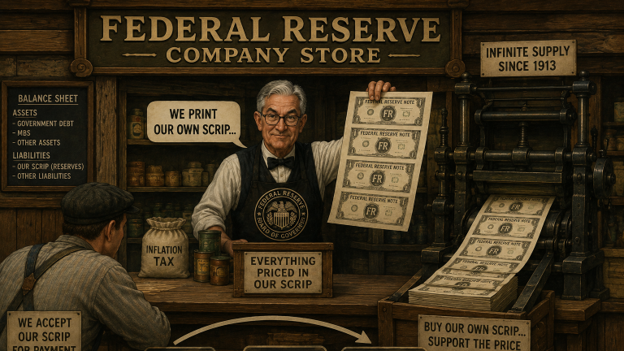
The Federal Reserve really does not want to be in the business of buying US Treasuries. But for the past year, it’s been back at it again, this time without any fanfare, and a new, muted euphemism. They used to call it “Quantitative Easing” but now they’re calling it “reserve management purchases” – no longer capitalizing their policy.
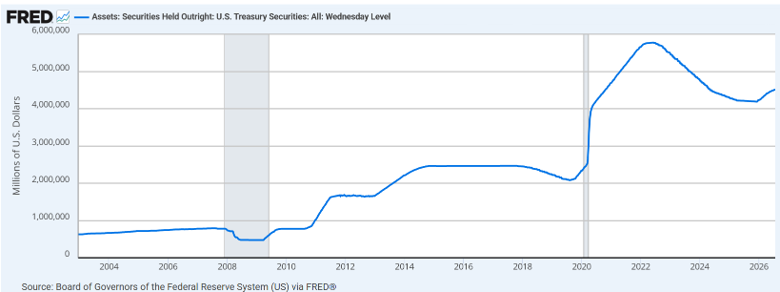
This latest attempt from the Fed to get out of the Treasury business, starting in 2022 has been the longest sustained effort we’ve seen.
But over the past year, the Fed is back to its old ways, stepping into the Treasury market as a net buyer.
That’s partially because (as I’ve discussed many times previously) foreign buying of Treasuries is drying up. Many US trade partners are now net sellers of Treasuries, putting more pressure on the Fed to come in as the buyer of last resort.
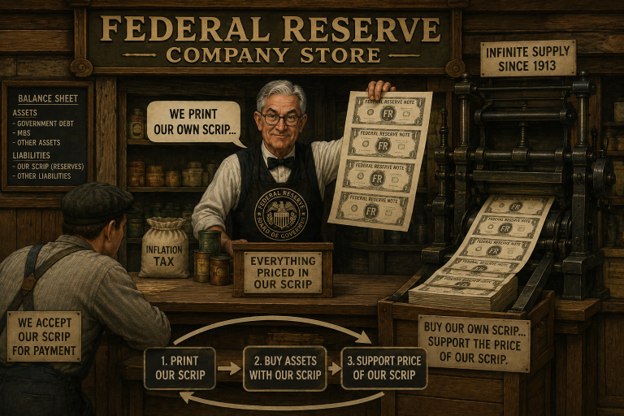
This situation is beyond perverse – because as you know, the Fed already controls the short end of the yield curve. They’re picking the price and deciding how much to buy. It’s a company store that prints its own scrip to buy its own scrip. Not good.
And it’s not just a stop-gap measure. Over 30% of the total $39 trillion in outstanding Treasury debt rolls over in the next 12 months.
Let’s also not forget that the US is adding almost another $1 trillion per QUARTER that has to get added to the pile.
The world does not have the ability or intention of buying $10 trillion+ in new Treasury debt in the next year.
Even worse: the Fed does not actually participate in live bidding of Treasuries, but instead, it buys old issuance in the open market. The Fed even has the gall to suggest that such buying decisions have nothing to do with funding the debt…
From the Federal Reserve website:
“All monetary policy decisions of the Federal Reserve—including buying and selling securities—are made independently of the borrowing decisions of the federal government and are intended solely to fulfill the mandate set out for the Fed by law: maximum employment and stable prices.
The Fed purchases Treasury securities held by the public through a competitive bidding process. The Fed does not purchase new Treasury securities directly from the U.S. Treasury, and purchases of Treasury securities from the public are not a means of financing the federal deficit.”
The beneficiaries of this buying? The same old dealer banks involved in the auctions. So the Fed plays frontsies-backsies and we’re not supposed to notice. Monetizing the debt is for “stability.”
There’s nothing stabilizing about printing money out of thin air to soak up Treasury debt. It will be wildly inflationary – just as we saw during the period between 2020 and 2022, but worse. Back then, the Fed bought just under $3 trillion worth of Treasuries.
Only about 21% of the $4.52 trillion owned by the Fed matures in the next year, meaning the difference it will potentially fund is about $9 trillion.
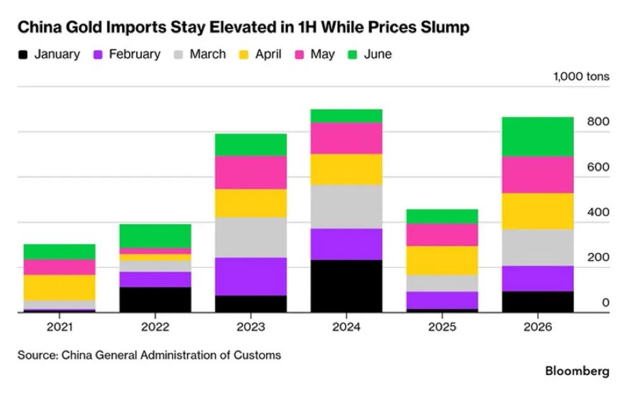
In the meantime and in stark contrast, China just imported 173 tonnes of gold in June – its largest single month purchase since 2024.
Be like China. When the price is low, it’s time to buy. Don’t wait for inflation as an indicator – it’s always a lagging (and underreported) statistic.
Best,
Garrett Goggin, CFA, CMT
Lead Analyst and Founder, Golden Portfolio