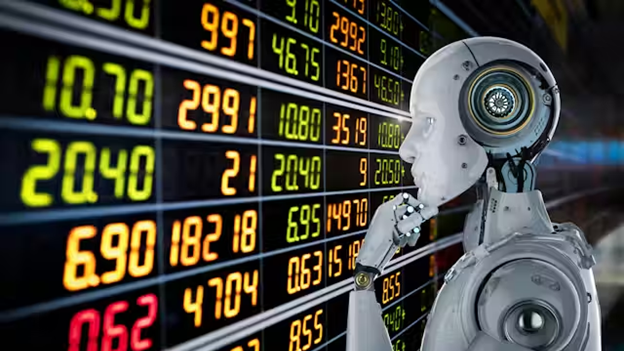
Computer trading programs run by the world’s largest investment firms will send some small gold stocks soaring in the coming months.
The story of how it works kind of sounds like science fiction, but I promise you: it’s real even though it does sound strange or even dangerous.
And look, if you can’t already tell: I’m kind of a throwback in the investing world. I’m not sure there are many analysts like me left – certainly not many on Wall Street who are actually active in the market.
That’s because most institutions – including the massive investment banks and hedge funds on Wall Street – now rely on automatic artificial intelligence programs to do their buying and selling.
Across all major markets in the U.S., Europe and Asia, between 60-75% of all trading volume is done by algorithms and AI programs.
Almost all of it comes from large institutions who have the economy of scale to afford the most cutting edge AI, run on the fastest computers closest to the exchange to cut down on latency.
These algorithms and AI are obviously programmed and guided by human hands – though increasingly, we’re seeing “machine learning” take over even those roles.
Twenty years ago, large blocks of stock were still traded by open-outcry: brokers standing on the floor, settling bids and asks.
Those days are gone.
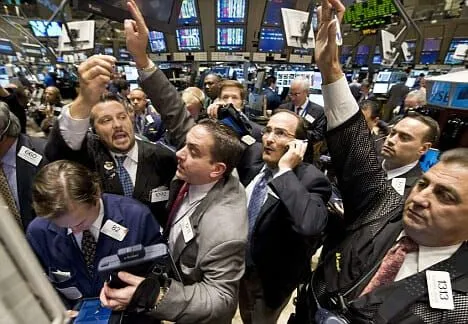
These guys are basically extinct. They can’t compete with the super fast supercomputers that have taken over.
No human being can. But this high speed AI trading also gives us a surprising advantage.
I’ve created an investment brief to explain how it works, but here’s the elevator pitch…
Some AI is programmed to find discrepancies between share price and underlying value. The AI gets its data live from reporting agencies like the SEC’s EDGAR website.
When you hear “high frequency trading” it’s referring to the speed at which these programs receive data, determine what it means and execute trades within milliseconds.
It’s a form of information edge – getting to the market before any other market participants are able to digest and act on the data.
But until this data is made public and pushed out via EDGAR (and other sources) the AI won’t act. It can’t. It has nothing to act on.
As small cap gold investors, we have an advantage. My research is all about making educated projections about future earnings based on my deep understanding of the gold business.
AI does not even look for companies that aren’t generating cash flow from operations. But most of the gold companies I cover are pre-revenue. So when a company goes from pre-revenue to posting its first revenues, Wall Street AI sees the massive imbalance between the share price and the underlying value. And it buys shares, pushing up the price to meet the now obvious fair value.
But not a moment before…
That’s because Wall Street AI can’t see what I see. It can’t go to a gold mine, look at core samples, meet with mining executives or analyze how much profit a gold miner will produce BEFORE it mines a single ounce and produces revenue for the first time.
I can tell you within a pretty narrow margin of probability exactly how much profit a gold miner will generate – especially in the weeks leading up to a miner pouring its first gold.
It means we can jump in front of Wall Street’s most powerful trading programs during those last few weeks as gold production becomes imminent.
We can own shares of companies that are pre-revenue, and thus invisible to Wall Street AI.
Again, I’ve put together a full brief on how this works, including details about a company that’s just weeks away from going into gold production.
I think this firm is an easy 5X based on my projections.
You can read the full story here.
I believe this company will be one of the best performing gold stocks to own over the next few months. But you can still own it today well before Wall Street’s AI can catch a whiff.
Best,
Garrett Goggin, CFA, CMT
Lead Analyst and Founder, Golden Portfolio