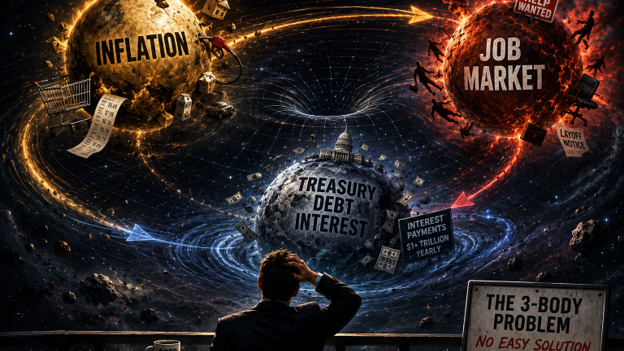
Fed Chairman Kevin Warsh faces an impossible problem. I don’t mean that figuratively. The constraints the Fed faces go beyond the ability of humans to understand or predict.
You might have heard of the “three body problem,” a physics concept that far exceeds the mathematical ability of humans to solve.
The original concept describes how it’s impossible to predict the trajectories of three different gravitational objects interacting in 3d space.
Two objects? No problem. That’s just basic Newtonian physics any AP high school student could solve. But once you add in a third body, the physics gets very complicated. The combined gravitational forces are hyper-dynamic. Body 1 doesn’t just interact with body 2 and body 3 individually, but in a combination that’s always changing.
The Fed faces a similar conundrum. Officially, it has a two body problem: a mandate to balance employment and inflation.
Like I said, a two body problem is easy. You can cool both inflation and employment with a rate hike. You can spur both with a rate cut.
But unofficially, the Fed has to deal with a 3rd body: US Treasury debt interest. Treasury debt interest goes up with a rate hike, making US debt less affordable. It goes down with a rate cut…
And it gets even more complicated (as the three body problem tends to do) because higher rates make Treasury debt issuance more attractive to buyers, while lower rates make Treasury issuance less attractive.
The Treasury needs buyers of its debt, or the Fed must come in and simply buy Treasuries with money created out of thin air – which is inflationary in and of itself.
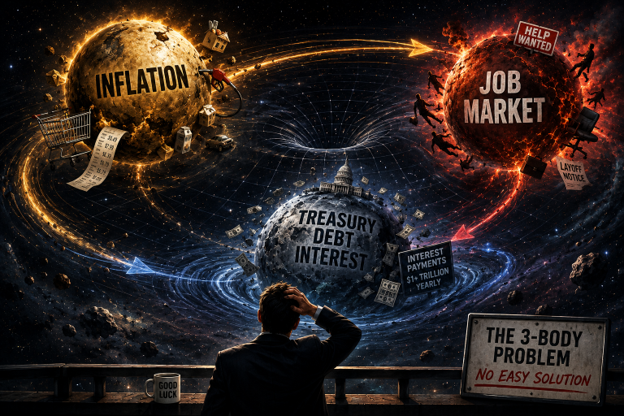
If you’re having a hard time keeping track of all the bodies in this problem, you are not alone.
It’s the same issue that Kevin Warsh is facing, right now.
The CPI report today came in at ~3.5%, which is slightly lower than expectations, and substantially lower than May’s 4.2% report.
The market has been pricing in a rate increase from the Federal Reserve – with the 30-year Treasury bumping above 5% again, after hitting similar marks in May.
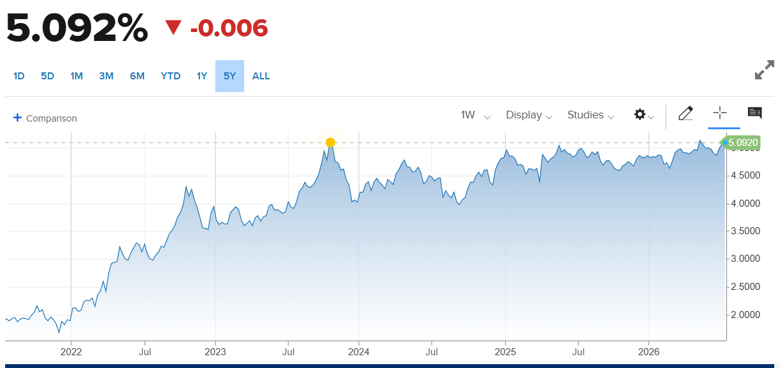
The last time the 30 year hit this level (before May of this year) was in 2023 – shortly after the Fed’s historic increase of 5% between March 2022 and July 2023.
In early 2024, the Fed started cutting again.
Today, with a slightly lower than expected CPI report, it seems like the Fed can avoid raising rates, and maybe even keep talking about a rate cut.
This tug of war must be no fun at all for Fed Chair Kevin Warsh. Warsh came into office in May under the assumption that he would get on board with President Trump’s rate cut preference.
But whatever narrative Trump wants to spin, Warsh still has to do the work of running the Fed, of keeping inflation and employment near target while also working with the Treasury to manage issuance.
It’s a 3 body problem that has no solution. If Warsh raises rates, he drastically increases the cost to finance Treasury debt while simultaneously choking out the job market. If Warsh cuts rates, he risks sparking runaway inflation (like we had in 2022), which causes prices to rise faster than wages.
If he does nothing, he still risks inflation or Treasury debt ballooning and the job market.
There’s no slack in this system. Treasury debt interest is already one of the largest Federal budget outlays.
You know what we call people or businesses who spend most of their income merely paying the minimum interest on their debts? Bankrupt.
And there’s no telling how all of this shakes out in a month from now, let alone a year or longer.
The only real bead we have on this system is the Fed’s long-time preference for inflation over deflation. Dollar devaluation means gold increases in price.
Invest accordingly.
Best,
Garrett Goggin, CFA, CMT
Lead Analyst and Founder, Golden Portfolio