Editor’s note: if you’re not yet a subscriber of Golden Opportunity, you can sign up to receive my newest gold and gold stock analysis (for free) here.
It was not that long ago when gold was the most commonly owned monetary asset held by central banks. If you look at the long-term history of central bank reserve assets, it was gold in the lead for hundreds of years, including most of the 20th century.
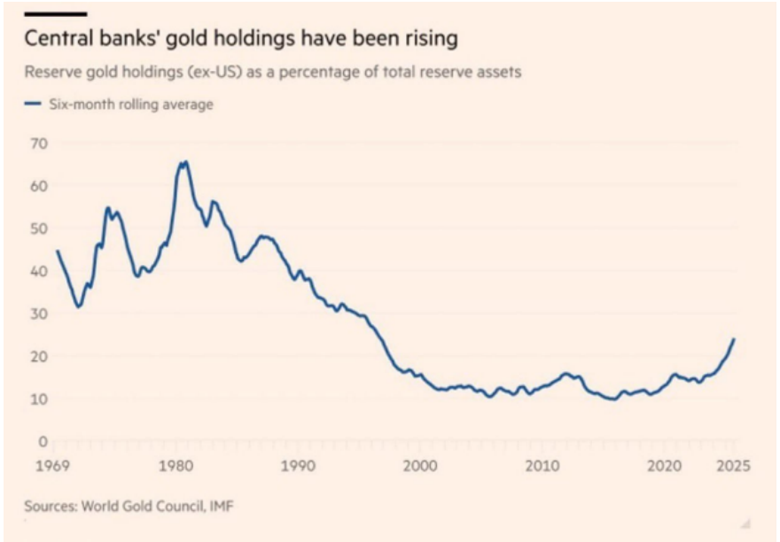
Going into the 1970s, central banks (not including the US) held about half of their total reserves in the form of physical gold, in vaults.
That number rose to ~65% as the price of gold soared going into 1980, and then for 40+ years, gold dropped, eventually to below 20% of reserves – in part due to the price collapse in the early 80s, but also because central banks were net sellers.
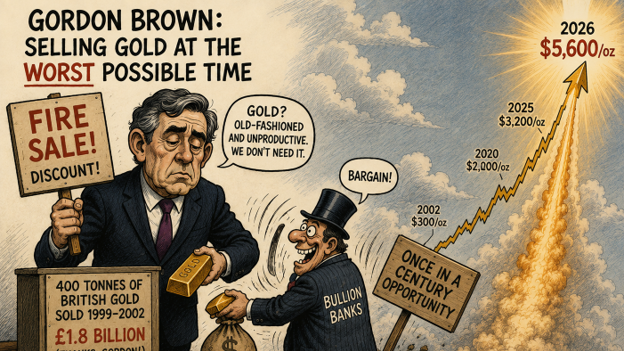
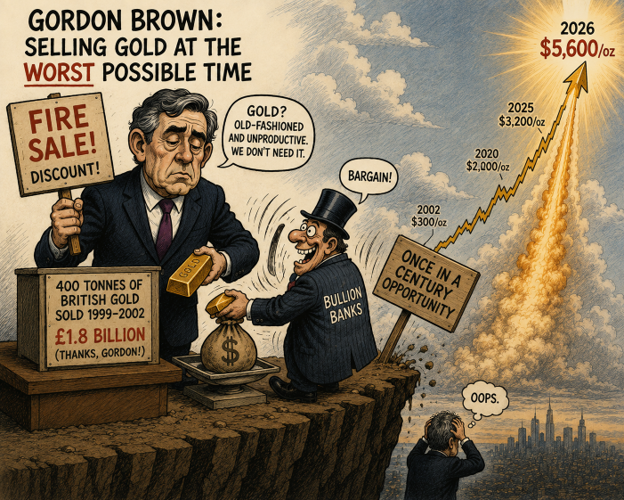
Some of these central banks sold their gold at the worst possible time. Gordon Brown, the head of the United Kingdom Treasury famously sold HALF of the UK’s gold starting in 1999, when gold was at 20-year lows of ~$250/oz.
For the past 5+ years, that trend has reversed, and for the first time since the 1990s, gold makes up over 20% of reserve assets held by central banks.
But even with this uptick, we’re still well outside of the “normal” level of gold held by central banks.
The percentage is rising for two reasons: banks have been net buyers of gold AND the price is going up, especially compared to fiat assets, and gold’s share of reserves benefits from both trends.
But let’s say that gold once again becomes a normalized 40-50% holding for central banks. In order to get there, these banks would have to double the amount of gold they hold today and/or the price of gold would have to double from current levels.
The unwinding of gold as a reserve asset did not happen overnight. It happened over a period of decades. And gold’s resurgence to current levels took 5+ years.
It could be another 5 years before gold could get back to historical levels as a reserve asset.
That would mean some combination of gold getting to ~$8k/oz or central banks buying another 28,000 tonnes of gold between now and 2031.
The problem is there really isn’t another 28,000 tonnes lying around at any price.
If you’re a central banker – first off, I’m very flattered that you’re taking time out of your day to read this, and if at all possible, please get me an invite to Gordon Brown’s poker game – but also, you’re looking at the same math.
As much gold as you want to own, you know you can’t buy it all at once, but the longer you wait, the more you are likely to pay. China seems to be leading the pack in this regard, having imported 173 tonnes of gold in June 2026, and the third month in a row of increased imports.
The Gold Pullback Everyone’s Misreading
Gold’s down $1,500 from its January high, and the crowd is sprinting for the exits. History says that’s a big mistake. Because even after the fall, gold still sits higher than it did a year ago — and a “crash” that leaves you up year-over-year isn’t a crash at all. It’s a breather. And a breather gives you a second shot at the miners that ran away from you in 2024 — the ones you swore you’d grab on the next dip. This is the dip. Don’t miss it.
Go here to see my top miners to buy before this buy window closes.
In 2026 so far, China imported about 865 tonnes of gold, which amounts to about 25% of annual global gold mining output.
To put it mildly, China is deadly serious about stockpiling as much gold as possible. The Bank of Korea also recently restarted gold purchases for the first time in 13 years.
And it’s not just sovereign imports… As I’ve mentioned many times, Tether is buying 2 tonnes of gold per week to back Tether Gold, its gold token.
The race is on. China is winning, but central banks are all jockeying.
And our gold holdings are primed to benefit.
Best,
Garrett Goggin, CFA, CMT
Lead Analyst and Founder, Golden Portfolio
P.S. If you’d like to receive (free) issues of Golden Opportunity in your inbox: click here to sign up.