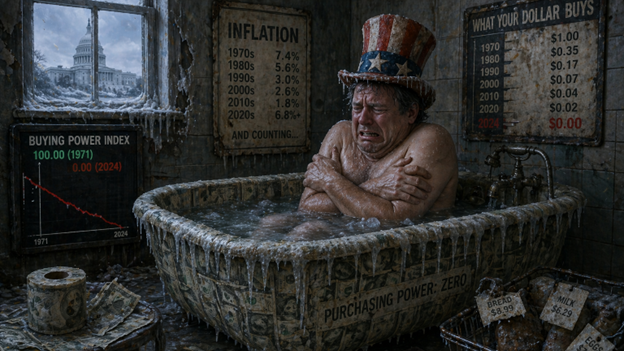
Whether we like it or not, we’re in the middle of a currency war – and we’re losing.
That’s hard to really put into context, because a currency war doesn’t feel like much, day to day.
While you can see headlines about a shooting war, with bombs falling in Iran, or the Strait of Hormuz being closed – and gas prices climbing at the pump – a widespread currency war doesn’t have any real day to day “feel” to it.
It takes decades to destroy a currency – whittling it down slowly a percent or three every year.
That means that even on a monthly basis, you can scarcely tell much has happened. You’ve heard of the boiling frog phenomenon: if you drop a frog into a pot of boiling water, it will jump out. But put a frog in a pot of room temp water and slowly raise the heat, the frog won’t even notice it’s boiling to death.
But losing a currency war is more akin to being in a bathtub full of hot water as it cools. At first it feels nice and warm, eventually all of the heat is gone, and you’re sitting in a tub of tepid water, shivering.
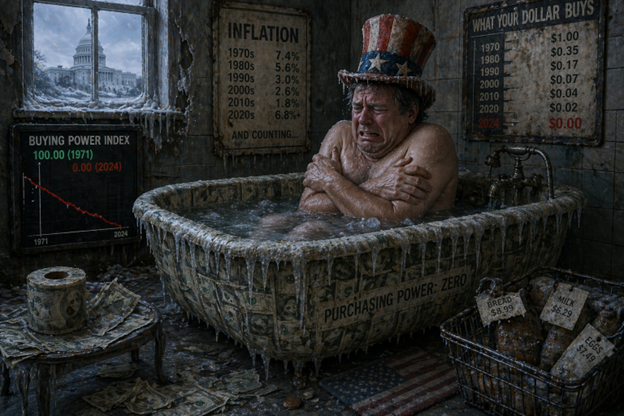
You don’t die. You just get increasingly uncomfortable. Your standard of living is being slowly dissipated away – until you have no choice but to get out.
That’s what we’ve been seeing with the US dollar for the past 50+ years.
Eventually, even our most oblivious creditors stopped feeling some warmth – seeing a diminishing benefit from cycling excess dollars into oil and/or Treasuries.
Without overseas demand for Treasuries at auction, we’re faced with the genuine problem of having our Central Bank step in to soak up the excess. They don’t have any money either. So they have to print the difference.
For 2026, the US Treasury will sell $32+ trillion in Treasury securities: 33% of which is short term (a year or less maturity.)
Meanwhile, our biggest creditors have started to walk away from the auction table. They can’t all leave at once – and they know that. So they’ve been slowrolling their exit as best they can.
Treasuries as a share of foreign reserves have been tumbling for 25 years:
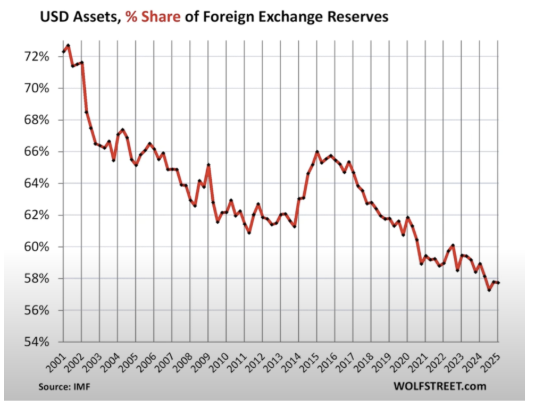
The dollar is losing this war.
There’s no question.
No one: friend or foe, even disputes this truth.
And while you don’t see explicit headlines about “the dollar losing the currency war” – you see plenty of other headlines that say basically the same thing.
Here is just the first page of results you can find if you google something like “Americans struggling with higher prices.”
Home Prices Up 45% Since 2020 — Wages Didn’t Keep Up
— TIME, January 2026US Birth Rate Hits Another Record Low — And Economics Is the Reason
— CNN / CDC, April 202671% of Americans Say Having Children Is Not Affordable
— The Hill / CDC American Family Survey, April 2026Half of American Women Reach 30 Without Becoming Mothers
— PBS NewsHour, April 2026The Starter Home Is Gone: Houses Now Cost 5x the Median Income
— Independent Institute, April 2026A Third of Adults Are Raiding Their Savings Just to Get By
— CNBC / McKinsey, December 2025Beef Up 15%. Coffee Up 19%. Housing Up 14%. Wages: Flat.
— CNBC / Bureau of Labor Statistics, December 2025250 Million Americans Face Health Insurance Hikes That Dwarf Their Raises
— Century Foundation, December 2025The US Lost 700,000 Births Since 2007 — And the Trend Is Accelerating
— NPR / CDC, April 2026
Prices don’t just go up by themselves. We’re seeing our currency getting destroyed.
And our creditors are now ditching the dollar for gold.
The question is: what can we do about it? What’s the best way to make sure we don’t get sunk along with the dollar?
I’m putting together a new research project dedicated to answering these questions.
It’s called “America’s Secret Gold War” and I’ll be publishing this project next Wednesday.
In it, I will reveal the exact steps you need to take to prosper during the later innings of this currency war.
Stay tuned…
Best,
Garrett Goggin, CFA, CMT
Lead Analyst and Founder, Golden Portfolio